
Engineered Wide Plank Hardwood Flooring
Our wide plank flooring is mainly sourced from Canada. At times, we will use lumber from the US if we cannot source locally. Our hardwood flooring is installed in Restaurants, shopping areas, office space, cottages, and homes. These floors range greatly in appearance and are available in many species. Depending on variables such as specie, stain, width sizes, scraping, and milling style, the possibilities are endless! All our wide plank flooring is unfinished and needs to be sanded and finished once it is installed. Species include but are not limited to red oak, white oak, quarter and rift sawn oak, walnut, white ash, red pine, cherry, hemlock, red maple, grey elm and red elm. All the material is kiln dried to ensure stability. It’s available in solid construction or engineered. Thus enables our product to be installed in all sorts of applications and locations. A key benefit to our plank flooring is the element of texture.
Benefits of Plank Hardwood Flooring
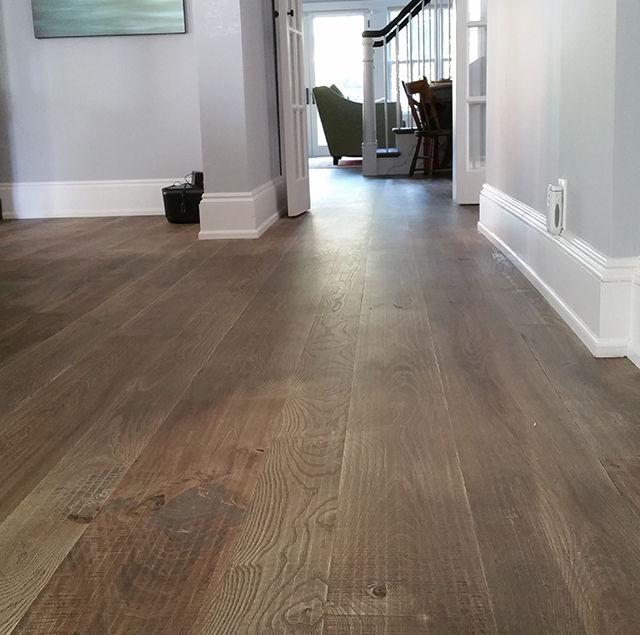
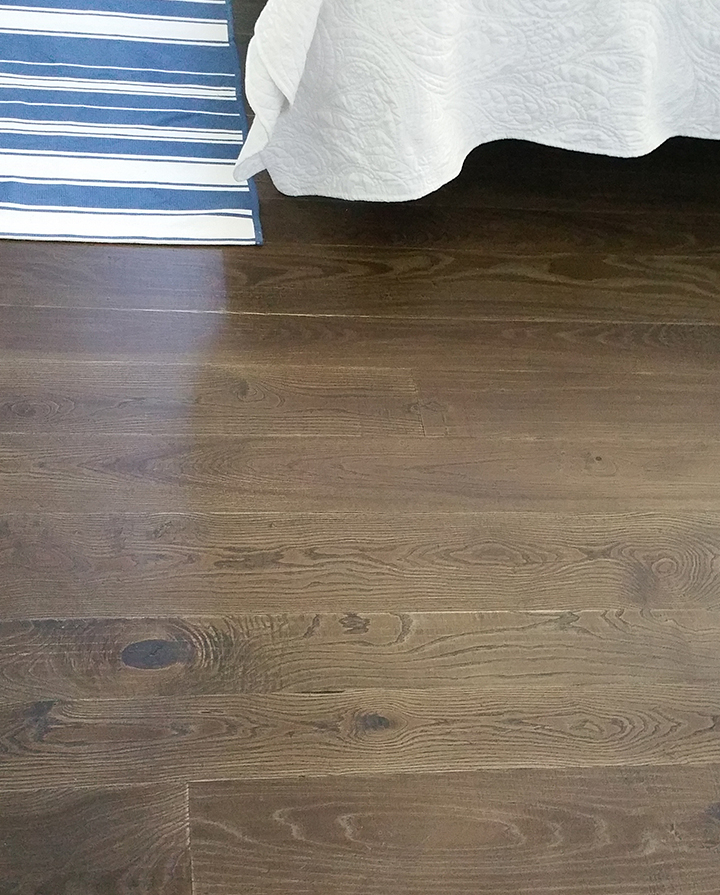
There are 2 main benefits. First, texture can greatly alter the look or appearance of any hardwood floor. Generally, it can add a great deal of rustic character to any specie of wood. For example, if an oak floor is sanded flat and stained in a deeper brown tone, it can have a formal appearance. Conversely, if the oak floor has texture and is stained in a custom driftwood colour, it can make the floor look more organic, aged, rustic, and lived in. Many types of texture can be added to any hardwood floor to enhance the wood. Saw marks are a great feature to our hardwood flooring. It adds dimension and character. The amount of saw marks can vary as well, anywhere from 90% coverage on the top of the floor boards, to 5% coverage. It just depends on the ambience that is trying to be created. Sometimes, the desired look is to see the sawn marks, but not to feel them. That can be achieved by trowel filling the entire hardwood floor. Then the floor is sanded. The sanding reveals the saw marks, yet the sawn marks are barely felt or are undetectable to the touch because the filler has filled in the low spots. Still, other methods such as scraping add texture. Again, a hardwood floor can be heavily scraped to create a very dramatic sensation. Or the scrapes can be more subtle and subdued, creating a more low-key appearance. Wire brushing and other techniques are also effective in adding texture to hardwood flooring.
The second benefit of having texture on a hardwood floor is that the texture makes the flooring more forgiving and easier to live with. Picture a coffee table. Think of the full gloss, jet black finish applied to the flat panels of wood. It looks great. But would it be very forgiving to live with? Would you want that finish on your floor? Would you want your dog walking on it, or your children playing on it? Would you want that finish on your floors in your cottage? Would you want that finish to be in your place of business? For all these questions, the answer is likely to be no. The finish on the coffee table looks great but it would be a nightmare to maintain and keep looking great if it were a hardwood floor. Now think of a coffee table where the sheen is lower, the colour is a warm grey, and the boards are textured. You can feel the texture and see it. With a finish like this, it becomes much more forgiving! When texture is applied to our floors, they become dog proof, child proof, restaurant proof, and suitable just about anywhere. Having texture on a hardwood floor is the single most important element to have to make it forgiving and liveable.
Other Options
Antique/Reclaimed Flooring
Custom Plank Flooring
New Wide Plank Flooring Demo
Custom Plank Flooring Demo
Patterned Flooring
FAQ
What is engineered wide plank flooring?
Engineered wide plank flooring is basically a clever construction that gives you beautiful, broad floorboards. Think planks that are noticeably wider than the traditional narrow strips, often five inches or more across. The “engineered” part refers to how it’s made: a top layer of real hardwood (like Oak or Maple) bonded to multiple layers of plywood. This structure is key. So, when we talk about engineered hardwood flooring in wide planks, you’re getting that expansive, high-end look combined with smart construction.
How does engineered wide plank flooring differ from solid hardwood?
The main difference lies right in the construction. Solid hardwood, like the name suggests, is one solid piece of wood top to bottom. Engineered hardwood flooring, on the other hand, has that layered build we just talked about – real wood on top, stable core below. What this means for you is increased stability. Engineered planks tend to handle changes in humidity and temperature better than solid wood, making them less likely to dramatically expand or contract. This construction difference also gives engineered hardwood flooring more versatility in where we can install it.
Is engineered wide plank flooring suitable for basements or humid environments?
Generally, yes! This is actually one of the big advantages of engineered hardwood flooring. Because of its layered structure, it’s much more stable and resistant to warping or buckling caused by moisture fluctuations compared to solid hardwood. This makes it a really good option for areas like basements, kitchens, or spaces built on a concrete slab where humidity can be a concern. While it’s not completely waterproof (you still need to manage spills), engineered hardwood flooring is definitely our go-to recommendation for these trickier below-grade or potentially damp areas.
What customization options are available for engineered wide plank floors?
You have lots of ways to make engineered wide plank floors your own! The real wood top layer comes in various species – Oak, Hickory, Maple, Walnut, you name it – each with its unique look. While we’re talking wide planks, there are still different widths to choose from. Then you’ve got a whole range of factory-applied stain colours and finish sheens (like matte, satin, or semi-gloss). Many engineered hardwood flooring options also offer different surface textures, such as smooth, subtly wire-brushed, or even hand-scraped for a more rustic feel. We can help you sort through all the choices!
Can engineered hardwood flooring be installed over existing floors?
Yes, engineered hardwood flooring can sometimes be installed over an existing floor if the surface is stable, flat, dry, and suitable for the installation method. We look at what is already in place before recommending that approach. A sound wood floor or certain other hard surfaces may provide a workable base, while loose boards, moisture issues, uneven areas, or incompatible materials usually need attention first. Floor height also matters around doors, stairs, cabinets, and transitions between rooms. We prefer to assess the existing surface and the conditions underneath it so the new floor has a solid foundation and performs properly over time.
How long does engineered hardwood flooring installation typically take?
The installation timeline depends on the size of the space, site conditions, floor design, and the amount of finishing work involved. Because we generally supply unfinished engineered hardwood flooring and finish it on-site, the project involves more than simply laying the boards. We may need time for preparation, installation, sanding, custom staining, and multiple finish coats. Patterned layouts, repairs to the substrate, or detailed colour matching can add time as well. A straightforward room may move relatively quickly, while a large custom project can take considerably longer. We review the space and project details beforehand so we can provide a more realistic schedule for the specific job.
Should engineered hardwood flooring be glued down, nailed, or floated?
The best installation method depends on the subfloor, the flooring construction, and the conditions of the property. We choose the method that gives engineered hardwood flooring the right support for the particular project rather than using one approach everywhere. Glue-down installation is especially useful over concrete, while fastening may be appropriate over suitable wood subfloors. Whether a floating installation makes sense depends on the product and site requirements. We also consider plank dimensions, moisture conditions, in-floor heating, and seasonal changes in the building. Reviewing those details first helps us recommend an installation method that supports both the appearance of the finished floor and its long-term stability.
Can engineered hardwood flooring be installed over concrete?
Yes, engineered hardwood flooring can be installed directly over a suitable concrete substrate. This is one of the applications where engineered construction can be particularly useful. Our floors use a real hardwood wear layer bonded to a stable plywood base, and we use Baltic birch plywood in our engineered construction. Depending on the project, the flooring can be glued directly to properly prepared concrete without first building a traditional wood subfloor. Before installation, we consider the slab’s condition, flatness, and moisture levels, along with factors such as in-floor heating. Proper preparation is important because even a well-made wood floor needs a dry, stable surface underneath it.